Preservation is public policy. Fully 70% of all full-time, paid jobs in historic preservation are driven directly by public policy, while the remaining 30% are deeply shaped by it. In the U.S., historic preservation policy, and the practice it drives, operate as a top-down, fabric-first model that has remained virtually frozen for half a century. By sidelining everyday human experience, this approach systematically ignores pluralistic perspectives, emotional connections to place, and the complex cultural contexts that shape history.
An outdated paradigm. By prioritizing physical materials over people, today’s public preservation policy remains bound to an orthodox doctrine established by a narrow cohort of elite policymakers whose views no longer reflect our diverse society—if they ever did.
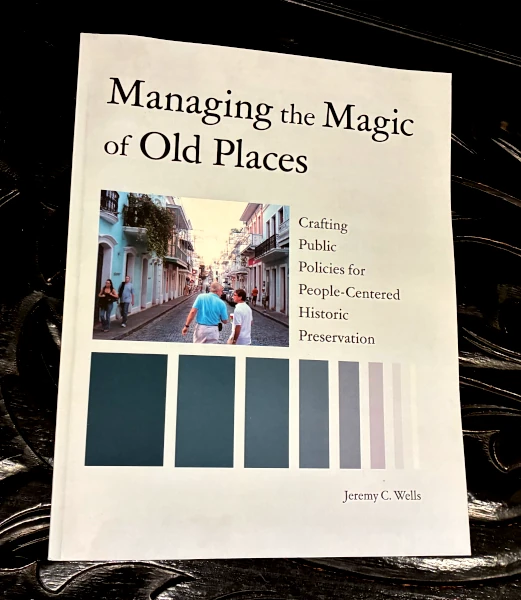
A roadmap for change.Managing the Magic of Old Places articulates a bold vision for a public preservation policy that genuinely serves the public interest. This book bridges high-level theory with pilot-ready tools to capitalize on the profound emotional connections, psychological attachments, and lived experiences people have with older environments—i.e., the “magic” of old places. It provides practitioners, scholars, and decision-makers with a clear path to transition the field toward a responsive, human-centered paradigm.
Who is the audience for this book?
For practitioners:
Above-ground cultural resource management (CRM) professionals: Consultants, historians, and compliance specialists who direct Section 106 reviews, evaluate NR eligibility, and prepare regulatory documentation. This book provides these individuals with the empirical evidence and policy frameworks needed to partner with broader advocacy coalitions to change public policy from within—leveraging their insider credibility with decision-makers.
Local preservation planners: Municipal staff and directors who manage local historic district commissions, conduct design review, and administer preservation ordinances. Operating under specific ordinance requirements, these professionals often face rigid constraints in their day-to-day regulatory roles. This book equips them with pilot-ready concepts, procedural templates, and policy language to advocate for changes to local policy, such as ordinances and guidelines, giving them the leverage to build institutional coalitions that reform municipal processes.
Urban and regional planners: This book offers ways to integrate community-based, heritage-led development into broader municipal goals, using participatory planning tools that prioritize local knowledge.
For policy makers & elected officials:
Actionable tools: The book provides pilot-ready instruments—including procedural templates, checklists, and step-by-step implementation guides—to help municipal, state, and federal actors reform public policy.
Inclusion & social equity: It offers a concrete framework for democratizing public participation, ensuring historically underrepresented groups have a direct voice in how older places are recognized, treated, and utilized.
More resilient communities: By protecting the intangible sense of place and local character that residents value, policymakers can foster stronger community cohesion, civic pride, and sustainable urban revitalizations.
Relevance & public support: Shifting from regulatory compliance to community engagement and empowerment moves public preservation policy from a policing action to one of building broader public buy-in.
For academics & scholars:
Interdisciplinary synthesis: The book bridges built heritage conservation with environmental psychology, urban planning, and environmental design research.
Theoretical rigor: It compels scholars to reexamine fundamental assumptions about significance, authority, and power dynamics, opening new avenues for empirical research into how built environments affect human emotion, perception, and well-being.
Reviews
“Wells’ work demonstrates notable analytical strengths, most prominently in its clarity and coherence. The argument is tightly constructed and logically sequenced, with a clear three-part structure, diagnosis, theory, and tools, that guides the reader seamlessly from identifying the limitations of conventional preservation practice to proposing people-centred solutions. Importantly, this conceptual rigour is matched by policy pragmatism: rather than remaining at the level of critique, Wells offers concrete, pilot-ready instruments for municipal actors, including checklists, procedural templates, and concise ‘how-to’ boxes that translate theory into actionable steps.” — Jana Das Chaudhuri, review of Managing the Magic of Old Places in Built Heritage, vol. 10, no. 25 (2026).
“Recommended. Lower-division undergraduates through faculty; professionals. … The need to reconsider where [public historic preservation] policy stands today is greatly needed. Extensive case studies, tables, and appendixes are provided. This is a great companion to Nature andthe Mind (2025), by Marc Berman.” — L. B. Allsopp, review of Managing the Magic of Old Places in Choice Connect, vol. 63, no. 10 (2026).
“Wells has articulated one of the most provocative and consequential critiques of contemporary preservation practice in recent years. The enduring value of the book lies not simply in its conclusions, but in the questions it compels the field to confront: Who defines significance? Who has historically been excluded from those definitions? And can preservation truly claim to serve the public if the public itself remains peripheral to the formation of preservation policy?” — Kathryn Rogers Merlino, review of Managing the Magic of Old Places in The Public Historian, vol. 48, no. 3 (2026).
“This is a unique read for anyone involved in urban planning, land use law, or heritage conservation. Wells successfully bridges the gap between high-level theory and practical policy, making a persuasive case that the future of our historic environments depends on our ability to embrace our vibrant, messy and deeply personal relationships with old places. It challenges us to rethink not just what we save, but why and who we are saving it for.” — Jennifer Hiatt, review of Managing the Magic of Old Places on Planetzen, (June 1, 2026).